
- You are here:
- Home »
- Blog »
- Dog Nutrition »
- The Complete Puppy Feeding Schedule Guide: Age-Based Meal Planning for Healthy Growth
The Complete Puppy Feeding Schedule Guide: Age-Based Meal Planning for Healthy Growth
Introduction
Most puppies need four meals a day at 8 weeks old, dropping to three meals by 3-6 months, and settling into two meals a day by 6-12 months. The exact timing depends on your dog’s breed, expected adult size, and individual body condition. Getting this schedule right affects everything from house training success to skeletal development and your pet’s long-term health.
This guide covers puppy feeding from 8 weeks through the transition to adult food, including meal frequency, sample daily timelines, portion guidance by breed size, and how feeding routines connect to potty training and obedience work. The target audience is new puppy owners who want structured, age-appropriate feeding plans that support both nutrition and training goals. Topics like raw diets, homemade food preparation, and medical nutrition fall outside this scope.
A consistent feeding schedule aids in potty training because puppies tend to eliminate within 10-30 minutes after eating. Pairing fixed meal times with potty breaks produces predictable patterns that accelerate house training by weeks compared to free feeding.
By the end of this article, you will have:
- Age-specific feeding schedules with sample daily timelines
- Meal timing strategies that support house training and crate training
- Portion guidelines adjusted for small breeds, large breeds, and giant breeds
- Methods for integrating feeding time with obedience training
- Solutions for common problems like food guarding, appetite loss, and inconsistent house training results

Understanding Puppy Nutritional Fundamentals
Puppy food is richer in nutrients than adult dog food. Puppies require minimum protein levels of 22-30% on a dry matter basis, along with controlled ratios of calcium and phosphorus, essential fatty acids, and higher caloric density than adult formulas. Their metabolism runs at 2-3 times the maintenance energy requirement of an adult dog during peak growth phases. Feeding adult dog food to a young puppy deprives them of the nutrient density needed for bone, organ, immune, and neural development. For large breed puppies, wrong calcium-to-phosphorus ratios in non-growth-formulated food can cause skeletal disorders like osteochondrosis.
A regular feeding schedule does more than deliver balanced nutrition. Puppies thrive on routine, and fixed meal times create predictable elimination windows that make house training faster and more reliable. A puppy that eats at the same times each day will need a potty break at predictable intervals, giving owners a concrete training framework rather than guesswork.
Puppy Growth Phases and Nutritional Needs
Puppy development from 8 weeks to skeletal maturity spans several overlapping phases, each with distinct caloric and nutritional demands. Small breeds reach adult size around 10-12 months. Large breeds transition to adult food between 18-24 months. Giant breed puppies with expected adult sizes above 90 pounds may not reach skeletal maturity until 24 months.
During the early development phase (8-12 weeks), a puppy’s energy needs peak at roughly 2.5-3 times the adult maintenance energy requirement. A puppy’s digestive system is still maturing during this window, which is why very young puppies need food softened with water and split across frequent meals. By late growth (6-12 months for most breeds), energy requirements drop toward 1.5-2 times adult maintenance levels. Caloric needs for puppies change as they grow, and failing to reduce portions as growth slows leads to excess body fat and weight gain that stresses developing joints.
Feeding puppy food too long can lead to obesity. Transition to adult food around 12 months for small breeds; large and giant breeds should remain on growth formulas until 15-24 months because their bones are still developing. The transition itself should happen slowly over 7-10 days to avoid digestive upset, mixing increasing proportions of the new food with the old formula.
The Training Connection
Structured feeding makes house training measurable. A puppy fed at 7 AM will reliably need a potty break between 7:10 and 7:30 AM. Free feeding, where food sits in a bowl all day, eliminates this predictability because the puppy grazes at random intervals, producing irregular elimination patterns. Puppies should not be free-fed to prevent overeating and because it undercuts the strongest tool owners have for potty training.
Feeding time also serves as a daily obedience training session. Asking a puppy to sit before the bowl goes down, wait for a release cue, and eat calmly builds impulse control and reinforces leadership. These are the same skills that transfer to off-leash obedience and behavior modification in more advanced training contexts.
Age-Based Feeding Schedules
The following schedules align with veterinary consensus from the AKC, AAHA, and MSD Veterinary Manual. The exact clock times matter less than consistent spacing between meals. Pick times that fit your daily routine and stick with them.
8-12 Weeks: Four Meals Daily
Puppies aged 8 to 12 weeks need four meals per day. Their stomachs are small, their growth rate is at its peak, and they cannot consume enough balanced puppy food in two or three sittings to meet caloric demands. Puppies need approximately 1½ cups of food daily at 8 weeks, divided across four feedings, though this varies by breed and the caloric density of the specific puppy food.
Sample schedule: 7:00 AM, 11:00 AM, 3:00 PM, 7:00 PM. Space meals 4-5 hours apart. The last feeding should land at least 3 hours before bedtime to reduce overnight accidents.
At this age, soften dry food with warm water to ease chewing and digestion. Large breed puppies can typically stop needing moistened food around 9-10 weeks; small breeds benefit from softening through 12-13 weeks. Take your puppy outside for a potty break within 10 minutes of finishing each meal, then again 20-30 minutes later.
Small breeds may require frequent meals to prevent low blood sugar. Toy breeds under 5 pounds are especially vulnerable to hypoglycemia if fasting periods stretch beyond 4 hours during this window. Maintaining tight meal spacing for these puppies is a medical necessity, not just a preference.
Pair this feeding schedule with early crate training to establish a full daily rhythm: wake, eat, potty break, play, crate rest, repeat.
3-6 Months: Three Meals Daily
Puppies aged 3-6 months should be fed 3 times a day. The puppy’s digestive system has matured enough to handle larger portions across fewer sittings, and their activity levels have increased.
Sample schedule: 7:00 AM, 12:00 PM, 6:00 PM. This timeline fits most work or school schedules and keeps spacing at 5-6 hours between meals.
As your puppy grows, adjust food portions based on the feeding chart on your puppy food packaging, modified by weekly body condition checks. A puppy at healthy body weight has ribs you can feel but not see, a visible waist when viewed from above, and a tucked abdomen in profile. Puppies may need 50% more or fewer calories based on condition; a puppy putting on excess body fat needs a portion reduction, while a puppy with visible ribs may need more.
This phase is ideal for integrating feeding with basic obedience training. Reserve a small portion of the meal (keeping treats under 10% of daily calories) for training rewards during short sessions before mealtimes. Teaching sit, down, and wait before the bowl goes down builds impulse control.
6-12 Months: Two Meals Daily
Puppies 6-12 months can be fed twice daily. The typical schedule looks like an adult dog routine: 7:00 AM and 6:00-7:00 PM.
Breed-specific variations matter here. Large breed puppies and giant breed puppies may benefit from staying on three meals a day until 9-12 months because their growth phase extends well beyond what smaller breeds experience. Small breeds that matured early may already look and act like an adult dog at this stage but should continue eating balanced puppy food until 10-12 months to ensure complete and balanced nutrition during the final growth phase.
Large breeds need controlled food formulations to prevent joint issues. Excess calcium and calories during this period increase the risk of developmental orthopedic disease in growing puppies whose bones are still mineralizing. Use a puppy feeding chart calibrated to your dog’s breed, puppy’s current weight, and expected adult size rather than eyeballing portions.
Monitoring body condition is important for adjusting puppy food portions. Weigh your puppy weekly during this phase and track the trend. Rapid weight gain in large breeds correlates with a higher incidence of hip dysplasia. If your puppy’s body condition score starts creeping above a 5 on the 9-point scale, reduce portion size by 10-15% and reassess after two weeks. Spayed or neutered puppies also need fewer calories; energy requirements drop roughly 10-20% post-procedure, so adjust food amounts accordingly.
Fresh water should be available to puppies at all times, regardless of age or feeding schedule.

Feeding Implementation and Best Practices
Knowing the right feeding frequency means nothing without consistent execution. This section covers how to build and maintain a feeding routine, along with comparisons of different feeding methods and their effects on training and health.
Creating Your Puppy’s Feeding Routine
Follow these steps to establish a reliable daily pattern:
- Set fixed meal times that you can maintain seven days a week. Puppies should eat at the same times each day, including weekends. Inconsistency resets the house training clock.
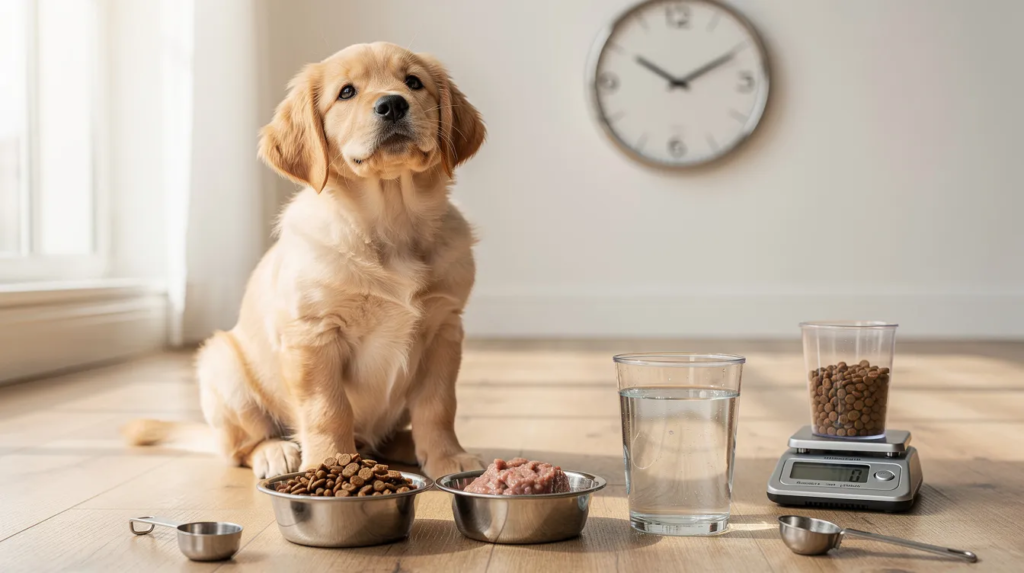
- Measure portions precisely. Use a measuring cup or kitchen scale rather than estimating how much food goes in the bowl. Start with the manufacturer’s recommendation for your puppy’s weight and age, then adjust based on weekly body condition assessments.
- Choose a consistent feeding location. Feed in the same quiet spot each time, away from high-traffic areas. This reduces anxiety, discourages food guarding, and keeps mealtimes calm.
- Remove uneaten food after 15-20 minutes. If your puppy walks away from the bowl, pick it up. Leaving food down teaches grazing, which undermines your feeding schedule and makes it harder to detect appetite changes that might signal illness.
- Avoid exercise 30 minutes before and 60 minutes after meals. For large breed puppies, vigorous activity around feeding increases the risk of gastric dilatation-volvulus (bloat), a life-threatening condition.
- Schedule a potty break immediately after each meal. Take the puppy to the same outdoor spot within 10 minutes of eating, wait for elimination, and reward success.
When transitioning from one age phase to the next (dropping from four meals to three, or three to two), eliminate the meal your puppy shows least interest in. If your puppy consistently leaves food at the midday meal, that is the one to cut. Make the transition gradual over a week, redistributing that meal’s portion across the remaining feedings.
Feeding Method Comparison
| Method | How It Works | Training & House Training Effect | Health Considerations |
| Scheduled Meals | Fixed number of meals at fixed times; bowl removed after 15-20 min | Creates predictable potty break windows; supports obedience cues at mealtimes; reduces begging | Enables precise portion control; easiest method for detecting appetite loss |
| Free Feeding | Food available in bowl all day | Weakens elimination predictability; makes house training slower; harder to use food as training motivator | Risk of overeating and obesity; difficult to track how much food the puppy actually consumed |
| Interactive Feeding | Meals delivered through puzzle toys, slow feeders, or enrichment devices | Slows fast eaters; provides mental stimulation; builds positive associations with feeding time | Reduces bloat risk by slowing intake speed; verify the puppy finishes the full portion |
Scheduled meals are the default recommendation for feeding puppies because they provide the clearest feedback loop for house training and the tightest control over portions. Interactive feeding works well as a supplement, especially for puppies that inhale their food in seconds. Free feeding undermines nearly every training goal and should be avoided for growing puppies.
Common Feeding Challenges and Solutions
Puppy Won’t Eat on Schedule
If your puppy refuses food at a scheduled mealtime, the cause is usually one of four things: stress from a new environment, teething pain (common at 3-6 months), dislike of the food texture, or mild stomach upset. Warming the food slightly or adding a small amount of wet food to dry food can increase palatability. Maintain the feeding schedule even when the puppy skips a meal; hunger will recalibrate appetite within a cycle or two. Never substitute table scraps or human food when a puppy refuses food, as this teaches the puppy that holding out produces better options.
If the puppy refuses food for more than 24-48 hours, or if the refusal comes with vomiting, loose stool, lethargy, or weight loss, contact your veterinarian. Appetite loss lasting beyond two days in a young puppy can indicate infection, parasites, or gastrointestinal obstruction.
Food Guarding or Aggressive Eating
Resource guarding during meals often develops when puppies feel their food supply is uncertain, or when they competed with littermates for access. Prevention starts with feeding each puppy separately in a calm, low-traffic space. Hand-feed small portions during early weeks to build trust. While the puppy eats from the bowl, periodically drop a high-value treat near the bowl, so your presence near food becomes a positive event rather than a threat.
Teach “leave it” and “sit” as prerequisites before the bowl goes down. If guarding behavior escalates to growling or snapping, work with a professional trainer who specializes in behavior modification rather than attempting corrections that can intensify the behavior.
Inconsistent House Training Results
When potty training stalls despite a feeding plan being in place, the problem is usually timing. Move the last meal earlier if overnight accidents persist; a puppy fed at 8 PM will not hold its bladder through a 7 AM wake-up. A last feeding at 5-6 PM with a final water cutoff two hours before bedtime gives the puppy’s system time to empty.
For very young puppies, keep meal spacing at a strict 4-5 hours and take the puppy outside after each meal, after naps, and after play sessions. Smaller breeds have smaller bladders and need more frequent potty breaks than larger breeds at the same age. If accidents occur at unpredictable times, track meals and eliminations in a simple log for one week. Patterns will emerge that reveal whether the feeding routine or the potty break timing needs adjustment. Combining this tracking with a structured crate training protocol usually resolves inconsistencies within 1-2 weeks.
Conclusion and Next Steps
A puppy feeding schedule built around age-appropriate meal frequency, consistent timing, and measured portions creates the foundation for healthy growth, successful house training, and early obedience skills. The core framework is straightforward: four meals a day at 8-12 weeks, three meals a day at 3-6 months, and two meals a day from 6-12 months onward. Adjust the timeline based on your dog’s breed and expected adult size, and transition to adult food gradually over 7-10 days when your puppy reaches skeletal maturity.
Start with these steps today:
- Set your puppy’s meal times based on the age-appropriate schedule above and commit to the same times daily.
- Measure portions using your puppy food’s feeding chart, adjusted for your puppy’s current weight and body condition.
- Choose a quiet, consistent feeding location and remove uneaten food after 15-20 minutes.
- Pair every meal with an immediate potty break and a brief obedience cue (sit or wait) before the bowl goes down.
- Weigh your puppy weekly and adjust portions if body condition trends too lean or too heavy.
These feeding habits connect directly to broader training goals. A structured puppy training program builds on the discipline and routine established at mealtimes, extending the same consistency into leash work, recall, and off-leash reliability.
Additional Resources
- Feeding schedule templates by age: Create a simple chart with columns for meal time, portion size, and potty break time. Pin it where you prepare the puppy’s food.
- Portion tracking: Record your puppy’s weight weekly alongside the amount you feed. Adjust portions up or down based on body condition rather than relying solely on bag guidelines.
- Body condition checklist: Ribs easily felt but not visible; waist visible from above; abdomen tucked when viewed from the side. Any deviation in either direction warrants a portion adjustment.
- Feeding-time training commands: Practice “sit,” “wait,” and “leave it” at every meal. Use up to 10% of the puppy’s daily caloric intake as training treats during sessions; subtract that amount from the next meal to keep total intake consistent.