
- You are here:
- Home »
- Blog »
- Puppy Training »
- How to Crate Train a Puppy: Complete Step-by-Step Guide
How to Crate Train a Puppy: Complete Step-by-Step Guide
Introduction
Crate training is one of the most important skills you can teach your new puppy, and starting it correctly from day one sets the foundation for house training, safety, and long-term behavioral health. Whether you’ve just brought home an 8-week-old Golden Retriever or a 4-month-old rescue pup, the crate training process follows the same core principles: patience, positive association, and gradual progression.
This guide covers everything you need to know about puppy crate training from approximately 8 weeks through 6 months of age. It does not address severe separation anxiety, trauma-based behavior, or medically induced anxiety disorders-those cases require professional behaviorist intervention. If you’re a new puppy owner in the Atlanta metro area looking for a structured, science-backed approach that accounts for Georgia’s climate, apartment living, and real-world scheduling demands, this is designed specifically for you.
Here’s the direct answer: Crate training involves gradually introducing your puppy to a confined space through positive associations, starting with 10–15 minute sessions with the crate door open and building over several weeks to 4–6 hours of comfortable confinement. The goal is to build positive associations so your puppy enters willingly and views the crate as a safe place rather than a restriction. Crate training can take days or weeks depending on the dog.
By following this guide, you’ll achieve four key outcomes:
- Accelerated house training through your puppy’s natural instinct to avoid eliminating in their sleeping area
- Safety during unsupervised time by preventing destructive chewing, ingestion hazards, and household accidents
- Travel and veterinary preparation so your pup remains calm during car rides and clinic visits
- A consistent daily routine that supports calm behavior, independence, and obedience development
Understanding Crate Training Fundamentals
Crate training is a den-based confinement method that leverages your dog’s instincts. Dogs are den animals-their wild ancestors sought out small, enclosed spaces with a single entrance for rest and security. A properly introduced crate mimics that den environment, giving your puppy a cozy space they associate with comfort and safety. Crate training helps your puppy feel secure while aiding with housebreaking and preventing destructive behaviors when unsupervised.
For owners, it provides predictability and peace of mind. You know your pup is safe when you step out, and your puppy learns to settle calmly rather than escalating into anxious or destructive behavior. According to the UC Davis Veterinary Behavior Service, puppies raised with structured environments-including appropriate confinement-tend to develop better self-confidence, less fearfulness, and stronger sociability.
Why Puppies Need Crate Training
Safety when unsupervised is the most immediate reason to use the crate. Puppies explore the world by chewing and swallowing, which means electrical cords, toxic plants, household cleaners, and small objects all become ingestion hazards. Crating your puppy during the short periods you can’t directly supervise keeps them puppy safe from these dangers.
House training acceleration is the second critical benefit. Dogs instinctively avoid eliminating in their sleeping area, which makes a properly sized crate one of the most effective potty training tools available. Puppy bladder control is roughly one hour per month of age during waking hours-so a 2-month-old can manage about 2 hours, while puppies can control elimination for 2–5 hours by age 4 months. Most puppies can sleep through the night (6–8 hours) without a bathroom break by around 4 months old.
Psychological comfort and routine round out the core benefits. The crate becomes your puppy’s own space-a place to decompress, nap, and feel secure amid the stimulation of a new home. Crate training works best through small, positive steps rather than long confinement, building your puppy’s confidence and independence gradually.
Benefits for Atlanta Dog Owners
Living in metro Atlanta adds specific dimensions to why crate training matters. Georgia summers bring intense heat and humidity, making travel safety critical-a crate-trained dog stays calm during car rides rather than panicking in confinement, which is essential when temperatures climb. Crate training also prepares your puppy for safe transport to the vet, groomer, or puppy training sessions without the stress of unfamiliar enclosures.
Atlanta’s apartment and condo living presents another practical reality. Many neighborhoods feature multifamily housing with limited space, and a crate gives your puppy a defined den without requiring an entire room. This also prevents damage to rental flooring, furniture, and walls while you’re away-protecting your security deposit and keeping neighbors undisturbed.
Then there’s Atlanta traffic. A commute that should take 30 minutes can stretch to over an hour, and crate training ensures your puppy remains safe if you’re delayed getting home. For a puppy around 3–4 months old, that means comfortable confinement for 2–4 hours without risk.
These practical benefits make choosing the right crate size, material, and placement-even more important for Atlanta pet owners.

Choosing the Right Crate Setup
Now that you understand why crate training matters and how it specifically benefits Atlanta dog owners, let’s get into the equipment. Choose a crate based on your dog’s adult size, and make sure the setup accounts for your home’s layout, temperature patterns, and your puppy’s breed characteristics.
Crate Types and Materials
Wire crates are the most versatile option for home use in Atlanta’s climate. They offer excellent ventilation-critical during warm months-fold flat for storage, and most include dividers so the crate grows with your puppy. The main drawbacks: they can be noisy on hard floors and feel exposed in bright or busy rooms. Covering a wire crate partially with a breathable blanket creates more of a den feel without trapping heat. Prices range from about $25 for a basic small model to $150+ for heavy-duty versions.
Plastic airline crates provide a more enclosed, den-like environment. Some dogs prefer enclosed crates for a sense of security. These are ideal for travel and veterinary transport, but they retain more heat than wire options-a real consideration in Georgia summers. They’re easier to clean than wire crates but come in more limited sizes.
Soft-sided crates work well for calm, non-destructive adult dogs or travel, but they’re generally not recommended for puppies who chew or might try to escape.
Heavy-duty steel crates serve strong breeds or determined escape artists. They’re expensive ($200–$350+) and heavy, but necessary for some larger breeds.
Plastic or metal crates are the most common options for dogs in the puppy stage. Furniture-style wooden crates have grown popular for their aesthetics-doubling as end tables or décor-but they sacrifice durability and chew resistance.
Crates should allow dogs to stand and turn around comfortably. For size calculation, measure your puppy’s projected adult height from floor to top of head (standing) and length from nose to base of tail. Add 3–4 inches to the length and 4 inches to the height. A divider can adjust crate space as your puppy grows, preventing the common mistake of giving too much room too early-which undermines house training when a pup can pee in one corner and sleep in another.
Essential Crate Accessories
Keep food and water bowls outside the puppy’s crate during longer crate sessions to avoid spills and messes. During short periods, a no-spill bowl attached to the crate works if needed.
Safe chew toys are essential for building positive associations. Kong toys filled with frozen chew treats, durable rubber toys, and food puzzles occupy your puppy’s attention and teach them that the crate equals good things. Rotate toys regularly to maintain novelty, and always choose a favorite toy that’s crate-safe-nothing small enough to swallow or soft enough to tear apart.
Bedding should be washable and breathable-a simple dog bed or folded towel works well. In Atlanta’s warmer months, avoid heavy plush bedding that can cause overheating. If your puppy is a determined chewer, start with an old towel rather than an expensive bed they’ll shred.
Feeding meals inside the crate (initially with the door open) is one of the fastest ways to build positive associations during meal time.
Optimal Crate Placement
Make the crate inviting by placing it in a lively area and adding comfortable bedding. Family spaces-the kitchen, den, or living room-work best because your puppy feels part of the household rather than isolated in a laundry room or back hallway. At night, consider placing the crate in your bedroom so your puppy can hear and smell you, which reduces overnight anxiety and crying.
Temperature matters significantly in Atlanta homes. Avoid placing the crate in direct sunlight, near heating vents, or on unconditioned porches. A wire crate in a climate-controlled room with partial covering provides the best balance of airflow and den-like comfort.
Minimize disruptions by keeping the crate away from windows with heavy foot traffic if your puppy is easily startled, but don’t isolate it so completely that your pup feels trapped and alone.
Setup essentials summary: Wire crate for home use with divider, placed in a family room, with washable bedding, safe chew toys, and meals served inside. Now let’s put this setup to work with the actual training process.

Step-by-Step Crate Training Process
With your crate selected, sized, and positioned, you’re ready to begin training. Remember: the crate should be a safe, cozy den rather than a restriction. Start a crate training routine as early as puppyhood—ideally the day your puppy comes home. Every phase builds on the previous one, and the entire crate training process typically spans 4–8 weeks depending on your puppy’s temperament and your consistency.
Phase 1: Introduction (Days 1–7)
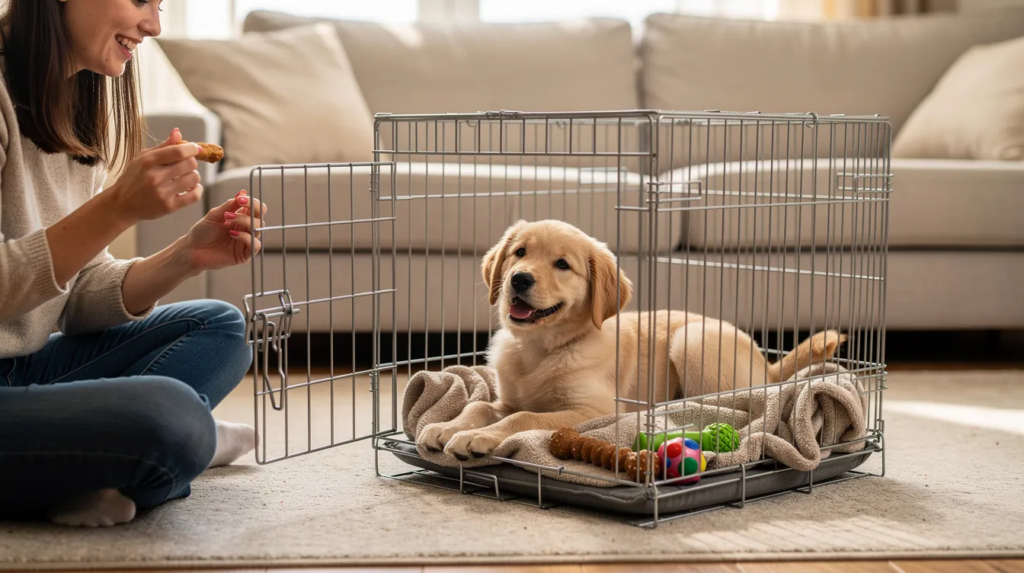
Start this phase on day one with your new puppy. The goal is simple: teach your pup that the crate is a wonderful place. Introduce the crate with open doors and encourage exploration-never force your puppy inside.
- Place the crate with the door open in your chosen family area. Let your puppy investigate on their own terms. Some will walk right in; others need time.
- Toss treats gradually deeper into the crate to build positive associations. Start just inside the entrance, then toward the middle, then the back. Use high-value treats your puppy loves.
- Feed all meals inside the crate with the crate door open. Place the food bowl near the front at first, then progressively toward the back as your puppy gains confidence.
- Begin closing the crate door briefly while your puppy eats-open it before they finish the meal. Gradually increase closed-door time over several feedings until your pup eats an entire meal with the door closed.
- Start short crate sessions of 10–15 minutes with the door closed while you remain in the same room. Offer a chew toy or frozen treat-filled Kong inside. Use calm praise when the dog enters the crate willingly.
By the end of week one, your puppy should enter the crate voluntarily, remain calm with the crate door closed for a few minutes to 15 minutes, and associate the space with food and rest.
Phase 2: Duration Building (Weeks 2–4)
Once your puppy handles 15-minute sessions comfortably, begin extending duration. Gradually increase crate time as your dog becomes comfortable-rushing this phase creates setbacks.
- Extend daytime sessions to 30 minutes, then 1 hour, then up to 2 hours during quiet times when you’re present but not directly interacting with your puppy.
- Introduce nighttime sleep in the crate. Start with the crate in your bedroom. Puppies younger than 12–14 weeks may still need one overnight bathroom break; by 4 months, most can sleep 6–8 hours through the night.
- Build distraction tolerance. While your puppy is crated, go about normal life-move around, have conversations, turn on the TV. This teaches your pup that crate time is simply part of daily life.
- Begin brief room departures. Leave the room for a few seconds, then a few minutes, then longer periods-always returning calmly. Keep arrivals low-key to avoid teaching your puppy that your return is an exciting event.
- Maintain the elimination schedule. Take your puppy outside to potty immediately after every crate session, after naps, after meals, and after play time.
Establish a predictable routine to help puppies thrive during crate training. Consistency in when the crate is used, when bathroom breaks happen, and when play and feeding occur creates a rhythm your puppy can rely on.
Phase 3: Independence Training (Weeks 4–8)
This final phase prepares your puppy for real-world scenarios-being home alone while you’re at work, running errands, or handling Atlanta’s unpredictable commute times.
- Practice leaving the house for short periods-5 minutes, then 15, then 30, then an hour. Don’t make departures dramatic. Simply crate your puppy with a chew toy, leave quietly, and return without fanfare.
- Build toward 4–6 hour daytime sessions for puppies around 4–5 months old. Puppies under six months shouldn’t stay crated over four hours. For younger pups, arrange midday bathroom breaks through a dog walker, neighbor, or puppy board and train program.
- Coordinate your elimination schedule with crate times: bathroom break first thing in the morning, after each meal, after naps, after physical exercise sessions, and before bed.
- Encourage independent crate entry. Teach a verbal cue like “kennel” or “crate” paired with a treat toss. Over time, your dog enters on command without needing a lure-the sign of a successfully crate-trained pup.
Never use the crate as punishment to avoid negative associations. The crate is not a time-out space. If your puppy associates it with being in trouble, you’ll undermine weeks of careful training.
Training Timeline Comparison
| Age / Stage | Max Crate Time (Daytime) | Max Nighttime Sleep | Key Milestones |
| 8–12 weeks | 10–30 min per session; ~1–2 hrs total between supervised free time | Wake once or twice overnight | Voluntarily entering crate, crate door closed briefly, feeding inside, first positive associations built |
| 3–4 months | 1–2 hr sessions; up to 3–4 hrs total with breaks | 4–6 hrs without accidents | Tolerating owner leaving room, fewer elimination accidents, calm during longer periods, play crate games for engagement |
| 4–6 months | Up to 4–6 hrs if schedule allows | 6–8 hrs nighttime sleep | Stable bathroom routine, independent crate entry on cue, comfortable with household distractions, reliable potty training |
Use this table as a general guide-every puppy develops at their own pace. Smaller toy breeds may need more frequent bathroom breaks due to smaller bladders, while larger breeds may need sturdier crates sooner. Gradually increase closed-door time to help puppies adjust to the crate at whatever pace works for your individual pup.
If you’re hitting consistent roadblocks at any stage, the next section covers the most common challenges and how to solve them.
Common Challenges and Solutions
Even with a perfect setup and consistent approach, most owners encounter at least one of these obstacles. Crate training is not a magical solution-it requires patience and problem-solving. Here’s how to handle the most common issues.
Excessive Whining and Crying
When your puppy cries or whines in the crate, your instinct is to let them out immediately. Resist this urge. Whining often indicates discomfort or anxiety in dogs, but it can also be simple attention-seeking behavior. If you open the crate door when your puppy is vocal, you teach them that crying equals freedom-and the whining will escalate.
The fix: Manage whining by waiting for a moment of quiet before releasing the puppy. Even 2–3 seconds of silence is enough to reward initially. Ignoring whining teaches dogs that quiet behavior is rewarded. Make sure your puppy has had adequate physical exercise, a bathroom break, and isn’t hungry before crate time. If the whining is persistent and panicked (not just fussy), verify there isn’t a legitimate need-sometimes a puppy’s cry signals they genuinely need to pee or are unwell.
Elimination Accidents in Crate
If your puppy is having accidents inside the crate, the most likely causes are: the crate is too large, the puppy is too young for the duration, or bathroom breaks aren’t frequent enough.
The fix: Use the divider to reduce crate space so your puppy has just enough room to stand, turn around, and lie down. Increase the frequency of bathroom breaks-during the 6–14 week stage, puppies need 8–10 elimination opportunities per day. Take your puppy outside for a potty break immediately after every crate session. Clean any soiled bedding thoroughly with an enzymatic cleaner to eliminate odors that might encourage repeat accidents. Don’t feel bad if progress is slow-bladder control is a physiological development process, not a training failure.
Destructive Behavior in Crate
Some puppies chew bedding, scratch at the crate door, or destroy toys inside the crate. This typically signals boredom, pent-up energy, teething discomfort, or anxiety.
The fix: Ensure your puppy gets sufficient physical exercise and play time before going into the crate-a tired pup is a calm pup. Provide appropriate, durable chew toys and rotate them to maintain interest. Frozen treat-filled Kongs are excellent for keeping a puppy occupied during crate time. If your puppy destroys bedding, remove it temporarily and use a simple towel or bare crate floor until the chewing phase passes. For puppies who seem genuinely anxious rather than bored, consider whether the crate is placed in too isolated a spot. Moving it closer to family activity areas often helps.
Refusing to Enter Crate
If your dog refuses to go near the crate, they’ve likely developed a negative association-possibly from being forced inside, startled while in the crate, or from the crate being in an uncomfortable location.
The fix: Reset by going back to basics. Place high-value treats near, then just inside, then deeper into the crate with the door open. Feed meals at the crate entrance, gradually moving the bowl inward. Never force your puppy inside. Some dogs respond well to having a worn t-shirt with your scent placed inside as a blanket. You can also play crate games-tossing a toy inside, letting the dog enter to retrieve it, and praising enthusiastically. Adjust the crate location if needed; sometimes simply moving it from a noisy hallway to a quieter room makes the difference.
Patience and consistency are the common thread across all these challenges. If problems persist beyond a few weeks despite consistent effort, or if your puppy shows signs of true separation anxiety (excessive drooling, self-harm, refusal to eat), professional training support or veterinary behaviorist consultation may be warranted. Separation anxiety may require professional behaviorist intervention beyond standard crate training methods.
Conclusion and Next Steps
Crate training is a process that unfolds over weeks-not days-and typically takes 4–8 weeks to fully establish depending on your puppy’s age, breed, and temperament. Gradual training helps prevent crate-related anxiety issues. The investment of time and consistency pays dividends in house training success, household safety, travel readiness, and your puppy’s overall confidence and calm behavior. Crate training also builds the foundation skills that older dogs and adult dogs carry throughout their life.
Your immediate next steps:
- Purchase the right crate for your puppy’s projected adult size-a wire crate with a divider is the most versatile choice for Atlanta homes
- Set up the crate in a family room with comfortable, washable bedding and 2–3 safe chew toys
- Serve your puppy’s next meal inside the crate with the door open to begin building that first positive association
- Start your first 10–15 minute closed-door session within the first 2–3 days, using treats and calm praise
- Establish a consistent elimination schedule with bathroom breaks after every crate session, meal, nap, and play session
Once your puppy is reliably crate-trained, you’re well-positioned to move into advanced obedience training and, eventually, off-leash control work. Crate training teaches your puppy to sit, wait, and stay in the crate on command-skills that translate directly to broader obedience. If you want to train your dog with professional guidance or need help with specific behavioral challenges, Off Leash K9 Training Atlanta offers structured puppy programs designed to build on home training foundations.
Additional Resources
- Crate selection guide: The AKC’s crate sizing recommendations provide breed-specific measurements and comparisons across crate types
- House training protocols: UC Davis Veterinary Medicine offers detailed elimination schedules by puppy age and science-based crate training guidance
- Night barking issues: If your puppy’s nighttime crying extends beyond the first few weeks, our guide on understanding dog barking at night covers causes and solutions
- Professional puppy training: The Puppy Power Combo program combines crate training support with socialization and obedience-currently available at a reduced rate for Atlanta-area puppy owners
- Free consultation: Contact Off Leash K9 Training Atlanta through our FAQ page to discuss your puppy’s specific needs and get personalized crate training recommendations
Related Posts
Multi-Dog Household Training Tips: Complete Guide to Managing Multiple Dogs
When to Start Puppy Obedience Training: Complete Guide for Atlanta Dog Owners
What Is an E-Collar for Dogs: A Complete Guide to Electronic Training Collars
How to Stop Puppy Biting: Professional Training Guide for Atlanta Dog Owners
Dog Friendly Restaurants Atlanta: Complete Guide for Dining Out with Your Pup
How Much Exercise Does a Dog Need: A Complete Guide to Daily Activity Requirements