
- You are here:
- Home »
- Blog »
- Training Tips »
- Multi-Dog Household Training Tips: Complete Guide to Managing Multiple Dogs

Multi-Dog Household Training Tips: Complete Guide to Managing Multiple Dogs
Training a multi-dog household requires a structured approach, consistency across every interaction, and a clear plan that accounts for each dog’s needs. Whether you’ve recently brought home a second dog, adopted a puppy into a family with a senior dog, or are managing several dogs under one roof, the challenges multiply alongside the rewards. Without deliberate training strategies, even well-intentioned dog owners can find themselves overwhelmed by competing behaviors, mealtime chaos, and escalating conflict between dogs.
In today’s blog, we cover the essential training fundamentals for multi-dog homes—from understanding social dynamics and structuring individual versus group training sessions to managing valuable resources like food, toys, and space. This guide is designed for dog owners with more than one dog who want practical, evidence-informed strategies to reduce inter-dog tension and build reliable obedience across the household. Dogs with significant aggression, a bite history, or serious resource guarding may require individualized professional guidance in addition to household management.
The core answer: Successful multi-dog household training combines individual training sessions for focused skill-building, clear and consistent expectations, structured resource management, and gradual introduction of group exercises. Training should prioritize clear teaching and reinforcement of desired behavior rather than relying on dominance as an explanation for household conflict.
Here’s what you’ll gain from this guide:
- How to establish calm, effective guidance without relying on force or outdated dominance models
- Strategies for reducing inter-dog conflicts around food, toys, beds, and human attention
- A framework for balancing individual and group training sessions for reliable obedience
- Practical resource management protocols that reduce opportunities for resource guarding and mealtime tension
- Structured routines that create predictability and harmony in your household
Understanding Multi-Dog Social Dynamics
Dogs living together naturally form social relationships, but those relationships are far more nuanced and fluid than the rigid “alpha dog” frameworks that dominated training advice for decades. Understanding how your dogs relate to each other is an important part of making thoughtful training and management decisions in a multi-dog household.
Natural Social Behavior Patterns
Dogs living together can form rank-related social relationships, but those relationships should not be reduced to a rigid “alpha dog” model. A study of 62 dogs in 31 multi-dog households found that higher-ranking dogs showed fewer signs of stress when their owner was present during a strange-situation test and showed fewer friendly behaviors toward a stranger. Older dogs also showed fewer stress behaviors but were friendlier toward the stranger. The study demonstrates rank-related behavioral differences, but it does not support treating one dog as a fixed “boss” whose status explains every household interaction.
Resource guarding can become an important management concern in multi-dog homes. Dogs may guard food, toys, resting areas, or other things they value. In a behavioral assessment involving 1,016 shelter dogs made available for adoption, 14.4% were classified as resource guarders, and 17.1% of those guarders were classified as severe. Severe guarders were more likely to be returned by adopters. Because this research involved shelter behavioral evaluations, these percentages should not be treated as prevalence estimates for dogs living in multi-dog households.
Reading dog body language is essential here. Watch for stiff posture, hard stares, lip curls, freezing, or a dog positioning itself between another dog and a valued resource. Also notice possible signs of discomfort or stress, such as turning the head away, lip licking, or lowering the body. Individual signals should always be interpreted in context rather than assumed to have one fixed meaning. Knowing each dog’s tolerance levels can help you manage interactions and create distance before tension escalates.
Your Role: Structure and Consistency
Managing a multi-dog household is not about establishing physical dominance or proving that you are the “pack leader.” Your role is to provide structure, predictability, clear communication, and appropriate supervision. Manage access to food, toys, space, and attention in ways that reduce unnecessary competition, and reinforce the calm behaviors you want to see more often.
Training multiple dogs requires balancing individual development and household harmony. Set clear expectations, manage feeding and shared spaces, and provide individual time with each dog. Consistency does not mean every dog must follow identical rules. A puppy, senior dog, and experienced adult dog may need different boundaries or expectations, but everyone in the household should apply each dog’s rules consistently.
This understanding of social dynamics directly shapes how you structure training, starting with individual sessions before progressing to group work.
Individual vs. Group Training Sessions
With a clear grasp of how your dogs relate to each other, the next step is designing training sessions that build skills reliably. One common mistake multi-dog owners make is trying to train all the dogs at once from the start. Divided attention and added distractions can make it harder to reward the right dog at the right moment, especially when new behaviors are still being learned.
Benefits of Individual Training
Individual training sessions make it easier to give one dog focused attention, tailor the pace to that dog’s learning speed, and reinforce precise responses to cues like sit, stay, and recall. Separate dogs during early training sessions for better focus. This prevents unnecessary interference and allows you to work on each dog’s specific challenges.
Keep individual training sessions short enough that your dog remains engaged; sessions of less than 10 minutes can work well for teaching and practicing skills. A survey study analyzing 689 dogs found that dogs receiving both pre-adolescent and adolescent/adult training had lower odds of owner-reported fear and anxiety. However, adolescent/adult training alone was not significantly associated with most of the behavior concerns measured. Because the study relied on owner-reported observational data, the findings show associations rather than proving that training caused the differences.
Individual time with each dog also gives you opportunities to work at the appropriate pace without competition from housemates. For dogs with concerns such as leash reactivity, aggression, or resource guarding, individualized support may be especially important. Private dog training allows more focused instruction, while dogs with significant behavior concerns should be matched with an appropriate behavior-focused program.
Group Training Implementation
Group training becomes valuable once each dog responds reliably to foundational cues in isolation. Introduce group training gradually to accommodate learning and reduce errors. Group sessions help dogs practice obedience in the presence of one of their biggest everyday distractions—each other. They can also help dogs practice waiting their turn and responding to cues while other dogs are nearby.
A useful technique is teaching each dog a group name cue—a single word that signals “everybody listen”—alongside their individual names. This helps distinguish cues for one dog from cues directed at the entire group. Practice turn-taking so each dog learns that another dog receiving attention or reinforcement does not mean it needs to rush into the session.
Group walks are easier once individual leash manners have been established. If one dog is still pulling, lunging, or becoming highly distracted, walking several dogs together can make it harder for the handler and the other dogs to remain focused. Build individual loose-leash skills first, then combine dogs gradually for structured walks.
Timing and Session Management
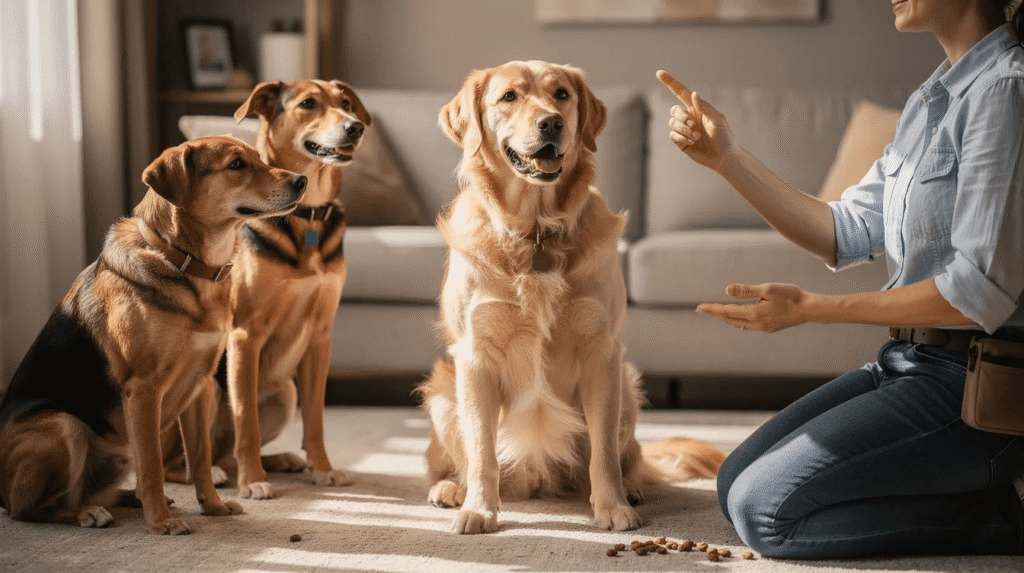
Rotate dogs during training to ensure individual attention. A practical approach is to work with one dog for 5–10 minutes while the others practice calm waiting in a separate room, crate, or designated area, depending on what each dog is comfortable with. Then rotate. This lets each dog receive focused development time while the others practice settling.
Rewarding calm behavior can also help reduce frantic behavior during multi-dog training. When a dog waits quietly while another dog trains, mark and reinforce that calm behavior. Over time, this can make turn-taking easier and training sessions more manageable.
The balance between individual and group work depends on your dogs’ skill levels, temperaments, and specific challenges. Early on, emphasize individual sessions while each dog learns foundational skills. Gradually add group practice as those behaviors become more reliable around distractions. This progression also makes it easier to manage multiple dogs during everyday routines.
Resource Management and Conflict Prevention
Training sessions build skills, but thoughtful resource management can reduce opportunities for conflict during daily life. Predictable routines can make a multi-dog household easier to manage. Meals, toys, beds, play, space, and human attention all require consideration when dogs have different preferences, histories, and tolerance levels.
Feeding Protocol for Multiple Dogs
Structured feeding routines can be especially helpful in multi-dog households because food can become a source of competition for some dogs. Feeding dogs separately can reduce opportunities for conflict and is particularly useful when resource guarding is a concern. Separation is a management strategy, however, and does not by itself treat the underlying guarding behavior. Learn more about dog aggression and resource-guarding support.
- Establish separate feeding stations with adequate distance between dogs. Different rooms can work well, with baby gates or closed doors providing physical separation when needed. If space is limited, staggered feeding may be another option.
- Use a “wait” and release cue when appropriate. For dogs that are comfortable around food, a brief wait before being released to eat can help practice impulse control. Do not use the exercise to challenge or confront a dog that already guards its food.
- Monitor meals and manage leftover food. If competition or guarding is a concern, pick up bowls after each dog finishes rather than leaving food available in shared areas.
- Practice “leave it” individually before adding distractions. Build the skill in a controlled environment before practicing around another dog. If a dog already shows significant resource guarding, avoid forced removal or confrontational exercises and seek qualified behavior guidance.
Toy and Space Resource Management
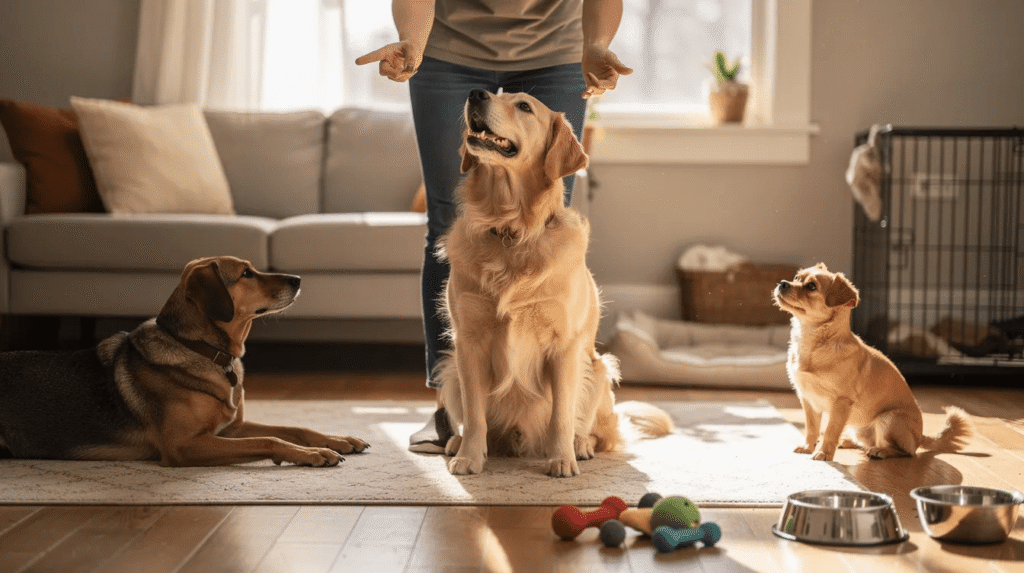
Beyond food, shared resources in your household may also need a management strategy. Individual resting areas can give dogs opportunities to relax without interference. Depending on the household, each dog may benefit from access to its own bed, crate, mat, or other quiet area.
| Resource Type | Management Strategy | Training Commands |
| Toys | Rotate access; supervise play with high-value items; remove items that repeatedly trigger conflict | “Leave it,” “drop it,” “wait” |
| Beds/Crates | Provide individual resting areas and teach each dog where to settle | “Place,” “go to your bed,” “crate” |
| Outdoor Spaces | Use structured access, practice door manners, and supervise play as needed | “Wait,” release cue, recall by name |
| Human Attention | Provide one-on-one time and reinforce calm waiting rather than frantic interruption | “Wait,” “station,” individual names |
Teaching a reliable “place” command can make busy times—such as arrivals, departures, visitors, or other high-arousal situations—easier to manage. Each dog learns to go to a designated station and remain there until released. This approach is also recommended by the AKC for multi-dog households as a way to practice calm waiting while another dog is working.
Dogs can benefit from learning to feel comfortable when separated. If your dogs have a history of conflict, resource guarding, unsafe play, or are not yet reliable together without supervision, use separate rooms, gates, crates, or other appropriate management when nobody is available to supervise them. When adding another dog to the household, gradual introductions and thoughtful supervision can reduce unnecessary conflict while the dogs adjust.
Understanding these management protocols prepares you to handle the specific challenges that arise most frequently in multi-dog homes.
Common Challenges and Solutions
Even with solid training and resource management, specific behavioral challenges can arise in households with multiple dogs. Monitor interactions, identify recurring triggers, and address developing problems before they become harder to manage.
Dogs Not Responding to Individual Names
When you have several dogs, name confusion can become frustrating. Dogs may learn to tune out names when they hear them repeatedly without a meaningful consequence, or every dog may rush to respond regardless of which name was called.
Solution: Name-response exercises help dogs learn to focus on their owner individually. Start in a quiet room with only one dog. Say the dog’s name once. The instant the dog looks toward you, mark the response with a “yes” or other established marker and provide reinforcement. Repeat until the response becomes reliable, then gradually practice with another dog present.
Use an individual dog’s name before a cue when clarification is needed—for example, “Max, sit”—so each dog learns when a cue is directed specifically toward them.
One Dog Disrupting Others During Training
In multi-dog homes, it’s common for one dog—often a younger or more excitable dog—to interfere with another dog’s training session. This can make it difficult for both the owner and the working dog to concentrate.
Solution: Station training is one practical way to manage this problem. Train each dog to go to a specific mat, bed, or platform and remain there calmly while you work with another dog. When needed, use a crate, separate room, or supervised leash or tether while the station behavior is still developing. Reward calm waiting and gradually increase the difficulty as each dog becomes more reliable. A board and train program may provide more structured practice for appropriate candidates, while dogs with reactive or aggressive behavior should be evaluated so the training approach matches their specific behavior and safety needs.
Inconsistent Obedience Between Dogs
Dogs learn at different rates. It’s common for one dog to master a skill quickly while another struggles, which can lead to uneven expectations and owner frustration. For example, a resident dog with years of training may perform reliably while a new puppy is still learning to hold a sit for a few seconds.
Solution: Different rules or expectations may be necessary for different dogs, at least temporarily. Adjust your criteria based on each dog’s skill level, age, and temperament. Provide individual time to address each dog’s current challenges. A senior dog that already knows a down-stay does not need the same session structure as a puppy learning it for the first time.
Track each dog’s progress separately and focus on improvement rather than comparing one dog directly with another. Practicing impulse control and calm waiting allows each dog to progress at an appropriate pace. Knowing each dog’s tolerance level can also help you avoid creating unnecessary frustration during group interactions.
Recognizing when challenges exceed what you can safely address on your own is equally important. Severe inter-dog aggression, escalating resource guarding, or a bite history warrants qualified professional guidance. For serious or escalating aggression, a board-certified veterinary behaviorist can evaluate behavioral and possible medical contributors and help develop an appropriate treatment plan.
Conclusion and Next Steps
Success in a multi-dog household comes down to structure, consistency, appropriate management, and respect for each individual dog’s needs. By understanding social dynamics without relying on outdated dominance myths, building skills through individual sessions before group work, managing resources proactively, and addressing challenges early, you can create a more predictable environment for every dog in the home.
Research comparing training approaches supports avoiding broad claims that e-collars are necessary for effective obedience. A 2020 study of 63 dogs with off-leash behavior problems compared three training groups. Dogs in the group whose trainers focused primarily on positive reinforcement showed better responses after a single instruction for “Sit” and “Come” and shorter response latencies than dogs in the e-collar group. The results apply to the behaviors and conditions studied and should not be generalized into a guarantee for every dog or training goal.
Start here:
- Assess your dogs’ current social dynamics. Observe behavior around resources, greetings, play, and other high-arousal situations. Note where tension develops and which situations require additional management.
- Establish an individual training schedule. Use short one-on-one sessions with each dog and adjust the exercises to that dog’s current skill level.
- Implement resource management protocols. Set up separate feeding areas when needed, provide appropriate resting spaces, and teach useful cues such as “wait,” “leave it,” and “place.”
- Gradually introduce group exercises. Begin with simple behaviors and structured walks, then increase duration and distractions as each dog’s reliability improves.
For help with off-leash obedience, aggression, reactivity, or other training challenges, professional guidance can provide a more structured plan based on the individual dog. Atlanta’s 1 Week Skills Refinement Program is specifically available to graduates of its one- or two-week Board & Train programs. Dog owners who are unsure which option fits their household can schedule a free consultation.
Frequently Asked Questions
How do I prevent fights over food in a multi-dog household?
Feeding dogs separately in different areas or at staggered times can reduce competition around meals. Physical separation is especially helpful when a dog guards food. Avoid confronting a dog over its bowl or forcing it to surrender food.
Can I train multiple dogs at the same time?
It’s usually easier to start with individual training sessions so each dog receives focused attention. Once foundational behaviors are reliable, gradually introduce group training with clear cues and structured turns to manage distractions.
How do I manage resource guarding among my dogs?
Separate dogs around known trigger items and manage access to food, treats, toys, and resting spaces as needed. Avoid forcibly taking guarded items or confronting the dog. Significant or escalating guarding should be addressed with a qualified behavior professional.
What if one dog disrupts another’s training session?
Use station training to teach dogs to wait calmly in designated spots while you train another dog. A separate room, crate, or supervised leash or tether can also help during early training. Reinforce calm waiting as reliability develops.
How important is individual time with each dog?
Individual time gives each dog opportunities for focused training, exercise, enrichment, and interaction without competition from housemates. It also lets you adjust activities and expectations to each dog’s age, temperament, and skill level.
Should all dogs have the same rules?
Not necessarily. Different dogs may need different expectations based on age, temperament, behavior, and skill level. The important part is applying each dog’s rules consistently so expectations remain clear.
Related Posts
When to Start Puppy Obedience Training: Complete Guide for Atlanta Dog Owners
What Is an E-Collar for Dogs: A Complete Guide to Electronic Training Collars
Signs of Stress in Dogs: Expert Guide to Recognizing and Managing Canine Anxiety
How to Stop Puppy Biting: Professional Training Guide for Atlanta Dog Owners
Dog Friendly Restaurants Atlanta: Complete Guide for Dining Out with Your Pup
How Much Exercise Does a Dog Need: A Complete Guide to Daily Activity Requirements