
- You are here:
- Home »
- Blog »
- Puppy Training »
- How to Teach Your Dog to Stay: Complete Guide for Lasting Results
How to Teach Your Dog to Stay: Complete Guide for Lasting Results
Introduction
Teaching your dog to stay means the dog holds a sit, down, or stand position until you give a release word. This single command prevents door-bolting, street-crossing lunges, and the kind of impulsive behavior that puts dogs in danger.
This guide covers basic to advanced stay training for dogs of all ages and breeds, from the first two-second hold to a rock-solid stay in a busy park. It does not cover specialized therapy dog certification protocols. The target audience is any dog owner working through impulse control problems: leash-pulling, jumping on guests, chasing squirrels, or general disobedience. Many dog owners find that a reliable stay command transforms daily walks, vet visits, and household routines.
Here is the core method: build three variables separately: duration (how long the dog holds), distance (how far you move away), and distraction (what competes for the dog’s attention). Use positive reinforcement and a consistent release cue throughout. The Three D’s rule includes duration, distance, and distractions in training, and each one must be solid before you combine them.
By the end of this guide, you will be able to:
- Master the three-pillar training method for teaching stay
- Build a reliable stay duration from a few seconds to 30+ seconds
- Proof the stay command against real-world distractions
- Troubleshoot specific failures like early breaks and distance anxiety
- Work toward off-leash reliability in outdoor environments
Understanding the Stay Command
The stay command is a stationary behavior: the dog holds a specified position (sit, down, or stand) until hearing a release word. Stay means the dog does not move from that spot for any reason until you end the exercise. A release word signals when a dog can move again. Common release words include “okay,” “break,” and “free.” Using a release word consistently helps dogs understand when the behavior ends.
The command’s primary function is impulse control and safety. Dogs that bolt through open doors, lunge toward traffic, or rush at other animals create real physical risk. A solid stay removes those scenarios by giving the dog a clear, practiced behavior to default to.
Stay vs. Wait Commands
“Stay” is a formal position hold: the dog remains in a specific posture until the owner returns and delivers a release command. The dog does not get up when you walk away, when someone knocks, or when food hits the floor.
“Wait” is a looser pause. Many trainers use it for brief holds at doorways or before crossing a street, where the dog pauses but isn’t locked into a particular posture. Cornell University’s veterinary program distinguishes the two by noting that “stay” carries a stricter expectation of stillness and duration. Building self-control through formal stay work carries into every other obedience context.
The Foundation: Sit and Down Positions
Before you start training stay, your dog needs to respond to the sit command and the down cue reliably in a quiet room. If the dog can’t hold a sit position or down position on verbal cue alone, adding “stay” on top creates confusion.
The down position tends to anchor dogs more securely than sit. The dog’s center of gravity is lower, and the posture is inherently more stable. For dogs that fidget in a sit, starting stay work from a down often produces fewer breaks. Whichever position you choose, pair it with a clear hand signal so the dog has both a verbal cue and a visual one.
Once your dog can hold position for a moment without a stay cue, you’re ready to layer in the three-pillar method.

The Three Pillars of Stay Training
These three variables form the framework for every stay training program. The AKC’s training guidance is direct: train each pillar separately before combining any two. Skipping ahead is the most common source of failure.
Duration: Building Time Tolerance
Start with 1-2 second holds. Ask your dog to sit or lie down, say the stay cue, pause for one second, then reward your dog while still in position. Increase stay duration by 1 second at a time. Every 5-6 successful repetitions, add a few more seconds. Intermix short holds with longer ones so the dog doesn’t predict when the reward comes and give up on harder reps. Start with a 10-second stay before adding distance. Once the dog holds for 10 seconds reliably, gradually increase the duration of the stay to 15 seconds, then work toward 30-second holds.
Distance: Adding Space Gradually
Once the dog can hold a 30-second stay with you standing right beside them, start adding distance. Begin by stepping sideways rather than backing up; moving directly away can trigger a follow reflex in most dogs. Take one step to the side, pause, return, and reward. Then two steps. Then add distance by backing away. Increase the distance from your dog only after they can hold a stay for a period. Always return to the dog to deliver the treat; do not call the dog to you, as that teaches the dog that “stay” ends when you move.
Distraction: Real-World Proofing
Introduce distractions last in the training process. Gradually introduce distractions after establishing duration. Start inside the house with mild stimuli: a family member walking past, a food bowl placed on a counter, a soft sound from a phone. Once the dog holds through those, move to harder challenges: doorbell sounds, toys tossed nearby, another dog visible at a distance. Use high-value treats (chicken, cheese) when different distractions are present; the reward must compete with whatever the environment offers.
Train all three pillars separately before combining. When you add distance, drop duration back. When you add distractions, reduce both distance and duration. Then gradually work each variable back up in the new context. Practice stay in various environments to build reliability.

Step-by-Step Training Method
With the three-pillar framework understood, here is the practical sequence for daily sessions. Teaching the stay command requires patience and consistency; short training sessions of 5 to 10 minutes help maintain dog engagement.
Initial Setup and Equipment
Use a low-distraction environment to start training the stay command. Start training in a quiet space to minimize distractions. Gather small, high-value treats that your dog finds compelling. A marker word (“yes!”) or clicker marks the exact moment the dog earns the reward. Keep a leash on the dog for safety during early outdoor sessions, but keep it loose so tension doesn’t become an unintended cue.
- Confirm your dog can sit or lie down on a verbal cue without luring.
- Choose a release word (“free,” “okay,” “break”) and commit to it. The release word means the exercise is over; use it in an excited tone for clarity. A release word can be used with any behavior, not just stay.
- Prepare 20-30 small treats per session. Plan 3-5 sessions per day, each lasting 5-10 minutes.
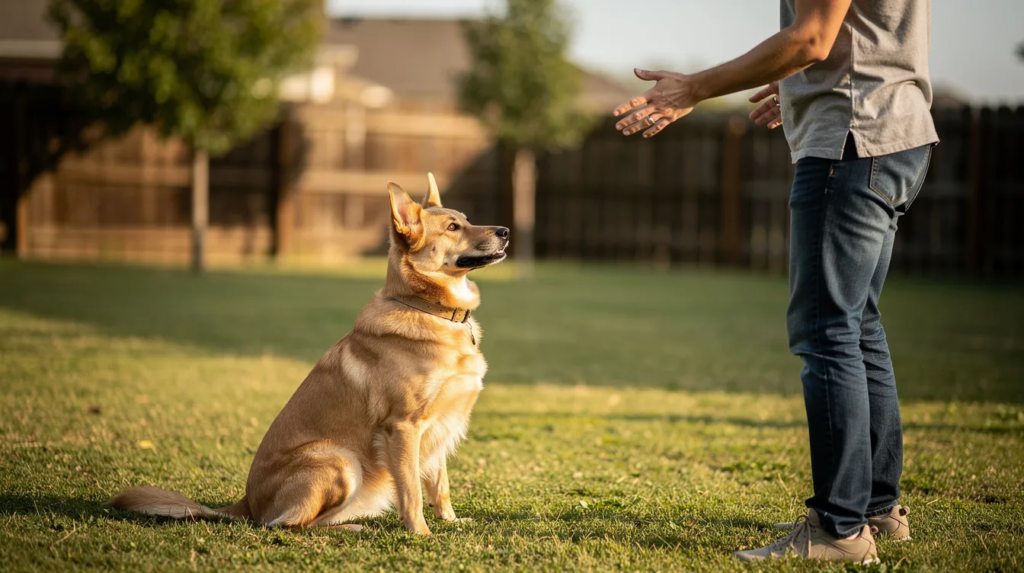
- Ask your dog to sit or down, deliver the stay cue with a hand signal (palm facing the dog), and reward after a 1-second hold.
- If the dog breaks position, calmly return your dog to the stay position. Avoid punishing your dog for breaking the stay command. Start with short durations to prevent breaking the stay. Increase difficulty gradually to avoid stay breaks.
Training Progression Timeline
| Week | Duration | Distance | Distraction |
| Week 1 | 1-5 second holds; reward each successful rep | Owner stands beside dog; no movement away | None: quiet room, no other people or pets |
| Week 2 | 5-15 second holds; gradually extend by 1-2 seconds per session | 1-2 sidesteps, then 3-5 steps back | Mild: someone walking past the room, quiet sounds |
| Week 3+ | 30+ second holds; build slowly toward 60 seconds | Across the room; briefly leave the room and return | Outdoor: other dogs at a distance, traffic sounds, park settings |
Adjust this timeline based on your dog’s responses. If your pup breaks more than twice in a row at a given level, drop back to the previous level for 2-3 sessions. Add distance only after achieving 30-second stays. Practice stay in various environments to improve reliability; a dog that stays in the kitchen but falls apart in the yard needs more proofing, not more repetitions at home.
Common Training Challenges and Solutions
Every dog hits plateaus during stay training. Here are the three most common failure patterns and how to address each one.
Dog Breaks Stay Before Release
When a dog breaks position before the release cue, the usual cause is that duration or distance jumped too far too fast. Your own body language can also trigger a break; leaning forward, shifting weight, or moving a hand toward the treat pouch can all look like a release to the dog. The fix: reduce duration by half, reward several successful holds at that shorter time, and rebuild. If your dog understands the stay cue at 5 seconds but breaks at 8, practice at 5-6 seconds for a full session before pushing to 7. Repeat until the pattern holds.
Refuses to Stay in High-Distraction Environments
A dog that holds a 30-second stay in the living room but can’t manage 3 seconds at a park is showing normal generalization failure, not stubbornness. Dogs learn context-specific behaviors; the park is a different world. Bring the dog’s highest-value treats outdoors and accept a basic stay of 2-3 seconds as a win. Gradually work up from there. A 2020 study comparing training schools (92 dogs across reward-based, mixed, and aversive programs) found that dogs trained with reward-based methods showed fewer stress-related behaviors and lower post-training cortisol. High energy environments demand better rewards, not harsher corrections.
Only Stays When Owner is Close
Some dogs hold position perfectly at two feet but collapse at ten. The dog’s stay depends on proximity reinforcement. To fix this, increase distance by a single step per session. Return to the dog to reward every time; never call the dog to come to you during stay practice, as that teaches the dog that distance itself is the release cue. If the dog is a puppy, expect shorter distances for weeks before progress; puppies have less impulse control capacity than adult dogs.
Patience and daily repetition solve all three problems. A 2017 meta-review of 17 studies found no evidence that aversive methods produce faster learning than positive reinforcement, and they carry documented risks to the dog’s mental and physical health.
Conclusion and Next Steps
The stay command rests on three trainable variables: duration, distance, and distraction. Train each one in isolation, build slowly, and use a consistent release word to mark the end of every rep. Reward the dog while still in position, not after breaking. The above steps, practiced daily, produce a reliable stay in most dogs within three to four weeks.
Your immediate action steps:
- Assess your dog’s current skill: can they hold a sit or down for 5 seconds without a stay cue? If not, begin there.
- Practice 3-5 daily sessions of 5-10 minutes each, focusing on duration only for the first week.
- Gradually increase one variable at a time: duration first, then distance, then distractions.
- Proof the stay in at least four different environments (house, yard, sidewalk, park) before considering it reliable.
Once you have a good stay in multiple settings, you can begin working toward off-leash reliability and integrating stay into dog sports, behavior modification programs, and everyday routines like greeting visitors or waiting at crosswalks.
Additional Resources
Off Leash K9 Training Atlanta offers board and train programs where dogs receive concentrated daily sessions in controlled environments, accelerating stay training through higher repetition volume. For owners who want guidance before committing, a free phone consultation can help evaluate your dog’s current duration, distance, and distraction levels and design a custom training plan. Stay training pairs well with recall, place, and heel work; each command reinforces the impulse control that makes the others more reliable.
Related Posts
Multi-Dog Household Training Tips: Complete Guide to Managing Multiple Dogs
When to Start Puppy Obedience Training: Complete Guide for Atlanta Dog Owners
What Is an E-Collar for Dogs: A Complete Guide to Electronic Training Collars
Signs of Stress in Dogs: Expert Guide to Recognizing and Managing Canine Anxiety
The Complete Puppy Socialization Checklist: Essential Experiences for Your Puppy
How to Stop Puppy Biting: Professional Training Guide for Atlanta Dog Owners