
- You are here:
- Home »
- Blog »
- Training Information »
- Why Do Dogs Howl at Sirens: Understanding Your Dog’s Instinctive Response
Why Do Dogs Howl at Sirens: Understanding Your Dog’s Instinctive Response
Introduction
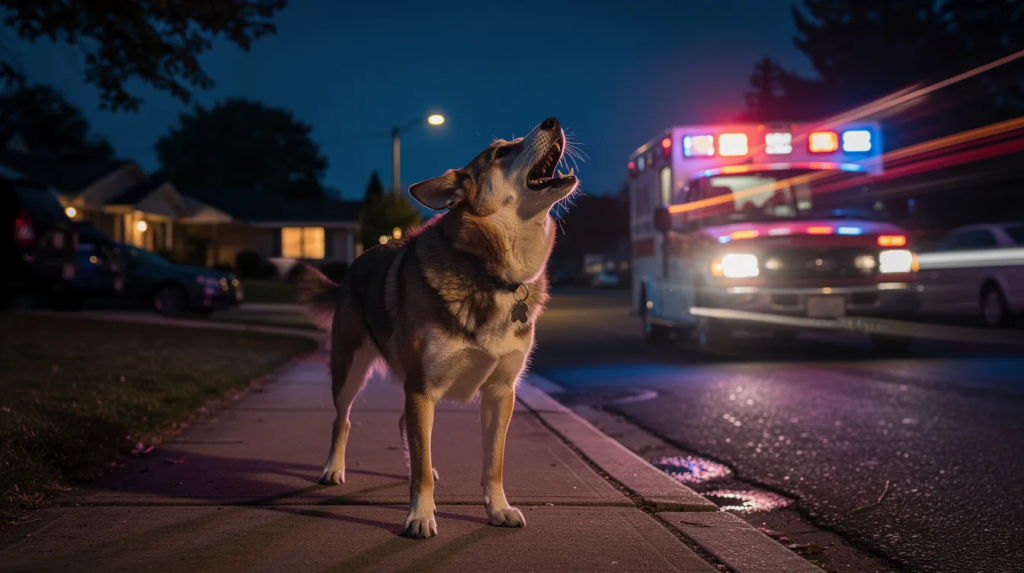
Dogs howl at sirens because these high-pitched, sweeping sounds closely mimic the howls of wolves and other dogs, triggering deeply rooted pack communication instincts that have survived thousands of years of domestication. If you’ve ever noticed your pup tilt back their head and let out a sustained howl the moment a fire truck or ambulance passes by, you’re witnessing instinctual behavior passed down from wolf ancestors.
This article covers the biological reasons dogs howl at sirens, the breed differences that make some canines more prone to howling, and practical training solutions you can implement at home. It does not address medical conditions that may cause excessive howling-those require a veterinarian. The content is written for dog owners, particularly those in the Atlanta metro area where frequent emergency vehicle traffic means regular siren exposure, who want to understand and manage their dog’s vocal responses.
The direct answer: Dogs howl at sirens because they perceive these loud sounds as distant howls from pack members. Siren frequencies overlap with the pitch range of wolf and dog howls, which activates an inherited social response to “answer back” and communicate their location.
By reading this article, you will:
- Understand how wolf ancestry drives your domestic dog’s howling behavior
- Recognize normal howling versus anxiety-driven or problematic vocalization
- Identify which breeds are most likely to howl at sirens and why
- Learn evidence-based techniques to manage siren-triggered howling
- Know when to seek professional training or behaviorist help
Understanding Canine Howling Instincts
Howling is a primal form of communication inherited from wolves-the primary long-distance vocalization method that canines have relied on for millennia. While dogs bark, whine, and growl in everyday life, howling activates a deeper, more ancient communication channel. Understanding this instinct is the first step to making sense of why your dog responds so strongly when sirens sound.
Wolf Ancestry and Pack Communication
Dogs descended from wolves over 15,000 years ago, and despite extensive selective breeding, the fundamental wiring for vocal communication remains largely intact. Wolves use howling to communicate over long distances-locating dispersed pack members across territories spanning 60 to 130 square kilometers, coordinating group movements, defending territory, and warning rival packs to stay away.
Wolf howls carry fundamental frequencies between approximately 150 and 780 Hz, layered with harmonically related overtones that make each howl distinctive and capable of traveling vast distances. This vocal architecture gave wolves an extraordinary survival advantage: the ability to stay connected as a pack across wild, sprawling landscapes. Domestic dogs retain this same vocal architecture. Even though your dog lives in a neighborhood rather than a forest, the neural pathways that produce and respond to howling remain active and responsive.
Modern Dog Vocal Communication
Domesticated dogs have adapted their vocal repertoire for life alongside humans. Most dogs bark far more frequently than they howl-short, sharp vocalizations suited for close-range alert and communication. But howling persists as a natural form of long-range signaling. Dogs may howl to signal their location to other dogs, to communicate with perceived pack members, or to express emotions ranging from excitement to distress.
Many dogs respond vocally to sustained, high-pitched sounds-musical instruments, other howling dogs in the neighborhood, and especially sirens. Research shows that domestic dogs can hear frequencies up to approximately 67,000 Hz, compared to the human ceiling of about 20,000 Hz. This means dogs hear overtones and frequency components in siren sounds that humans cannot detect, which partly explains why sirens trigger such strong reactions even when they seem unremarkable to us.
This sensitivity to sound sets the stage for understanding exactly why sirens-among all the noises in a dog’s environment-are so effective at activating these ancient communication pathways.

How Sirens Activate Howling Responses
The connection between wolf ancestry and modern siren howling becomes concrete when you examine what sirens actually sound like to a dog’s ears. Siren sounds share specific acoustic properties with wolf howls, and dogs’ social instincts do the rest.
High-Frequency Sound Recognition
Dogs can hear frequencies up to 67,000 Hz-far beyond what humans perceive. Their lower hearing bound is similar to ours (around 40–67 Hz), but that vastly extended upper range means dogs hear high-pitched sounds and overtones within sirens that are invisible to human ears. High-pitched sounds trigger dogs’ instinctual howling response because these frequencies overlap with the range used in wolf and dog howls.
Sirens from police cars, fire engines, and ambulances produce rising and falling frequency sweeps that closely resemble the modulation patterns in natural howls. A 2021 study by Kořanová et al. found significant acoustic similarity between wolf howls and technical sirens, concluding that sirens function as “supernormal releasing stimuli”-artificial sounds that inadvertently mimic natural communication signals so effectively that they trigger innate responses. Dogs may howl in response to high-pitched sounds like sirens precisely because their auditory system categorizes these sounds alongside genuine pack vocalizations.
The high decibel level can also startle or overwhelm sensitive ears in dogs, adding urgency to their vocal response. Standard emergency vehicle sirens often exceed 90 dB at close range, which is loud enough to demand attention without typically causing hearing damage during brief exposure.
Social Response Mechanisms
Dogs may mistake sirens for other dogs howling. When a siren wails through the neighborhood, your dog’s brain processes it much the way it would process a distant howl from another canine: as a social call that demands a response. Pack mentality drives this behavior-dogs are social animals hardwired to maintain contact with their group.
Howling back serves several social functions. Dogs may howl to communicate with perceived pack members, asserting their presence (“I’m here too”) or attempting to coordinate with what they believe is a distant caller. In multi-dog households or dense neighborhoods, this creates a chorus effect: one dog howls, which triggers other dogs nearby, reinforcing the behavior socially. This is why you may have noticed that when one howling dog starts up on your street, several others join in within seconds.
Some dogs howl to seek attention from their owners. If your reaction to the howling-talking to the dog, petting them, even laughing-provides social feedback, the behavior becomes reinforced and more likely to recur.
Territorial Alert Behaviors
Some dogs view the loud noise of a siren as a potential threat and howl to alert their family. This territorial response mirrors the wolf behavior of warning pack members about approaching danger. Your dog may perceive the approaching emergency vehicle as possible danger-an unknown, loud intruder entering their territory-and howl to warn you and protect the household.
Howling can indicate excitement or alertness in dogs, not just fear. The intensity and duration of territorial howling varies based on temperament, prior siren exposure, whether the dog is outside or near open windows, and general neighborhood noise levels. Dogs in quieter suburban areas may react more strongly to sirens because the sound contrasts sharply with ambient noise, while dogs in busier urban settings sometimes habituate over time.
These individual differences bring us to the broader factors that determine how intensely any given dog responds to sirens.

Factors Affecting Howling Intensity
Not all dogs howl at sirens, and among those that do, the volume, duration, and emotional quality of the response vary widely. Understanding what drives these differences helps owners set realistic expectations and choose appropriate management strategies.
Training Approaches for Managing Siren Howling
When siren howling becomes excessive or disruptive, structured training can reduce or eliminate the behavior. Professional behavior modification programs can provide guidance, but many owners can begin with these foundational steps:
- Train your dog to be quiet with a cue. During calm periods with no sirens, practice a “quiet” command. Say the word when your dog is already silent, then immediately reward with a high-value treat. Build the association between the word and the behavior before introducing distractions.
- Reward your dog for remaining quiet during sirens. When a siren passes and your dog stays calm, deliver treats and praise immediately. This positive reinforcement teaches your dog that silence during loud sounds earns good things.
- Gradually increase siren sound exposure. Use recorded siren sounds played at low volume during training sessions. Pair the sound with treats and calm interaction. Over days and weeks, gradually increase volume as your dog remains relaxed. This desensitization process rewires the dog’s response.
- Maintain a consistent positive reinforcement schedule. Use positive reinforcement to manage howling behavior over the long term. Consistency is critical-intermittent rewarding of quiet behavior is less effective than a reliable pattern. Avoid scolding your dog for howling at sirens, as punishment can increase anxiety and worsen the problem.
Breed Characteristics Comparison
Breed genetics play a significant role in howling tendencies. Dogs closer to wolves are more likely to howl, and certain breed categories have been selected for vocal traits that make siren howling more common. Some breeds, like Huskies, are more prone to howl at sirens, while others rarely vocalize this way.
| Breed Category | Howling Frequency | Typical Response | Training Considerations |
| Hounds/Hunting dogs (Beagles, Coonhounds, Foxhounds) | Very High | Sustained baying and howling; hounds are known for their vocal communication and were bred for long-distance signaling during hunts | Requires persistent counterconditioning; expect longer training timelines |
| Northern/Spitz breeds (Huskies, Malamutes) | High | Huskies and Malamutes are more likely to howl; ancient breeds are more prone to howling behavior due to closer genetic proximity to wolves | Channel vocal energy through exercise and mental stimulation alongside quiet training |
| Herding breeds (German Shepherds, Border Collies) | Moderate | May bark or howl selectively; alert-driven response more than social howling | Respond well to structured obedience commands; cue-based training is typically effective |
| Toy/Companion breeds (Chihuahuas, Bulldogs) | Low | Dogs bark more than howl; occasional howling usually learned rather than instinctual | Often respond quickly to redirection and environmental management |
Beagles and Coonhounds often howl at sirens because these hunting dogs were specifically bred to bay-a prolonged, howl-like vocalization used to signal game location to hunters across long distances. This breeding history makes them especially responsive to siren sounds that mirror the pitch and duration of their working vocalizations. Understanding your specific dog’s breed tendencies helps you calibrate expectations and training approaches accordingly.
Common Challenges and Solutions
For Atlanta dog owners dealing with frequent emergency vehicle sirens in an urban environment, managing siren howling presents some specific practical challenges.
Excessive Neighborhood Disturbance
When excessive howling disrupts neighbors, structured intervention becomes necessary rather than optional. Implement a consistent “quiet” training protocol using high-value treat rewards during practice sessions when no sirens are present. Close windows during peak traffic hours, use white noise or sound masking inside the home, and create a designated retreat space where your dog feels secure. For dogs that need more intensive help, board-and-train programs can incorporate sound desensitization into broader obedience training.
Anxiety-Driven Howling
Dogs may howl to express anxiety or distress, and this type of howling looks different from social or territorial responses. Signs include panting, trembling, hiding, pacing, or refusal to eat alongside the vocalization. If your dog shows fear or stress during sirens rather than simple alertness, counterconditioning is essential: pair siren sounds with your dog’s favorite treats, toys, or activities to build positive associations. Provide a safe, enclosed space your dog can retreat to during loud siren events. For dogs with severe noise sensitivity, reactive behavior training may be appropriate, and you should seek veterinary help for excessive howling behavior that persists despite consistent training.
Accidental Reinforcement of Howling
Many dogs learn to howl more because owners inadvertently reward the behavior. Talking to your dog during howling, rushing over to comfort them, or even making eye contact provides social attention that reinforces the vocalization. Instead, deliberately ignore the howling and reward calm, quiet behavior before, during, and after siren exposure. Rewarding silence-not punishing noise-is the most effective approach. In multi-dog households, address howling individually, as the chorus effect between dogs can create a self-reinforcing cycle that’s difficult to break without separating dogs during initial training.
Conclusion and Next Steps
Siren howling stems from normal canine communication instincts rather than behavioral problems. Most dogs that howl at police sirens, fire trucks, or ambulances are simply doing what their wolf ancestors programmed them to do: responding to what sounds like a distant call from a pack member. This is not a sign of pain, danger, or disobedience-it’s an echo of wild communication that has persisted through 15,000 years of domestication.
To manage your dog’s siren response effectively:
- Assess your dog’s specific triggers-note whether the howling reflects social response, territorial alert, or anxiety
- Implement basic quiet command training during calm periods before practicing with recorded siren sounds
- Monitor for anxiety signs (trembling, hiding, excessive panting) that indicate the response goes beyond normal instinct
- Maintain consistency in your own reactions-never scold, always reward quiet behavior
Related topics worth exploring include general noise sensitivity training for dogs reactive to thunderstorms and fireworks, and off-leash obedience work that builds reliable command response even during high-distraction situations like sudden loud sounds.
Additional Resources
Off Leash K9 Training Atlanta offers behavior modification programs specifically designed for dogs with excessive vocalization issues, including siren-triggered howling. Their trainers work with all breeds-from howling-prone hounds and ancient breeds to anxious companion dogs-using positive reinforcement methods tailored to each dog’s triggers and temperament.
If you’re concerned about your dog’s siren response intensity, a free phone consultation can help determine whether your pup’s howling falls within normal range or warrants professional intervention. For dogs requiring specialized attention management, in-home training options allow trainers to work in your dog’s actual environment, simulating real siren exposure under controlled conditions for effective desensitization.
Related Posts
Multi-Dog Household Training Tips: Complete Guide to Managing Multiple Dogs
What Is an E-Collar for Dogs: A Complete Guide to Electronic Training Collars
Signs of Stress in Dogs: Expert Guide to Recognizing and Managing Canine Anxiety
Dog Friendly Restaurants Atlanta: Complete Guide for Dining Out with Your Pup
How to Teach Your Dog to Stay: Complete Guide for Lasting Results